
Why Every Christian Is Called to Lead

Why Every Christian Is Called to Lead
Leadership is not reserved for pastors, ministry leaders or people with official titles. In God’s kingdom, leadership begins wherever disciples influence others towards Christ.
Many Christians hear the word leader and immediately think of a pastor standing behind a pulpit, a ministry director organising programmes, or a church elder making important decisions. While these are certainly leadership roles, the New Testament presents a much broader understanding of leadership.
The truth is that every Christian is called to exercise influence. Every believer is called to participate in the mission of Jesus Christ. In that sense, every Christian is called to lead.
Leadership Begins with Discipleship
One of the most common misconceptions about leadership is that it is primarily about authority or position. We often assume leadership belongs to those at the top of an organisation or those who possess special gifts and talents.
Jesus challenged that idea.
When his disciples argued about greatness and status, Jesus taught them that true leadership looks very different from the world’s understanding of power.
“Whoever wants to become great among you must be your servant.”
Mark 10:43
In God’s kingdom, leadership begins not with authority over others but with service to others.
Christian leadership grows out of discipleship. As followers of Jesus, we are continually being formed by his grace, transformed by the Holy Spirit, and invited to participate in his mission. Leadership is one of the natural expressions of that discipleship journey.
You Already Influence People
Whether you realise it or not, your life influences others every day.
Even simple acts of encouragement, kindness, faithfulness and integrity can shape another person’s spiritual journey.
Leadership is not measured by the number of people who follow us. It is demonstrated through our willingness to help people move towards Jesus.
A word of encouragement, a listening ear, a prayer offered at the right moment, or an example of faithful Christian living can have a profound impact. These everyday moments are often where Christian leadership is most clearly visible.
Leadership Is Participation with Jesus
An ACCM Definition
Christian leadership is participating with Jesus Christ in influencing people and communities towards God’s purposes through servant-hearted relationships, faithful discipleship and Spirit-led service.
This understanding changes everything.
Leadership is no longer about building our own platform or proving our abilities. Instead, leadership becomes participation in what Jesus is already doing.
We are not called to create our own mission.
We are invited to join Christ’s mission.
We are not called to build our own kingdom.
We are called to participate in his kingdom.
This perspective brings humility, freedom and purpose. We lead not because we are extraordinary, but because Jesus invites ordinary people to participate in his extraordinary work.
The Example of Jesus
Jesus is the ultimate model of Christian leadership.
-
✓
He demonstrated authority without domination. -
✓
He taught with conviction and humility. -
✓
He served rather than demanding to be served. -
✓
He invested deeply in people. -
✓
He equipped others for ministry. -
✓
He led through love.
From washing his disciples’ feet to giving his life on the cross, Jesus demonstrated that genuine leadership is sacrificial, relational and focused on the wellbeing of others.
Christian leaders do not simply admire Jesus. They learn to lead like Jesus.
Leadership in Everyday Ministry
Many people assume they need a formal ministry position before they can make a meaningful contribution. The reality is that leadership often develops through faithful participation in everyday ministry.
You might be:
-
●
Leading a small discussion group -
●
Mentoring a younger believer -
●
Serving on a ministry team -
●
Caring for people experiencing difficulty -
●
Encouraging members of your congregation -
●
Helping organise a church activity -
●
Supporting community outreach
Each of these opportunities allows us to exercise Christ-centred influence. Leadership is not confined to formal positions. It is expressed whenever we help others move towards God’s purposes.
Growing as a Christian Leader
While every Christian is called to influence others, intentional leadership development remains important.
Leadership is not a destination. It is a lifelong journey of formation. As Christians grow in their relationship with Christ, they become increasingly equipped to serve, guide, encourage and influence others in meaningful ways.
Every Christian Can Lead
The church needs pastors, elders, ministry leaders, teachers and administrators. But it also needs faithful disciples who recognise that leadership is not limited to formal roles.
Wherever God has placed you, you have opportunities to influence others for good.
You may never stand on a stage. You may never hold a formal title. But through your service, faithfulness, encouragement and witness, you can help others encounter the transforming grace of Jesus Christ.
That is leadership. And that is a calling shared by every Christian.
Ambassador College of Christian Ministry
Ready to Grow as a Christian Leader?
The updated Christian Leadership course explores leadership through a biblical and Christ-centred lens. It is designed for church members, ministry volunteers, emerging leaders and pastors who want to participate more effectively in God’s mission through servant-hearted, Spirit-led leadership.
More Posts
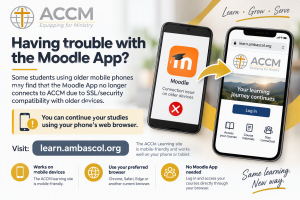
Having Trouble with the Moodle App on an Older Phone?
ACCM Student Notice Having Trouble with the Moodle App on an Older Phone? You can still access ACCM Learning directly through your phone’s web browser.
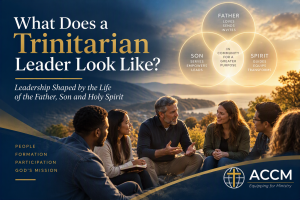
What Does a Trinitarian Leader Look Like?
Christian leadership begins not with power, position, or influence, but with the God who is Father, Son, and Holy Spirit. Discover how a Trinitarian understanding of God reshapes the way we lead, serve, and participate in God’s mission.
Updated Christian Leadership Course Now Live
Updated Christian Leadership Course Now Live Equipping disciples for servant-hearted leadership in the mission of Jesus Christ. Ambassador College of Christian Ministry (ACCM) is pleased
The Bible and Doctrines: ACCM’s New Foundational Course is Now Live
The Bible and Doctrines Now Live | Build a strong foundation in Scripture, biblical interpretation, and Christian doctrine through a Christ-centred and Trinitarian lens. At