
What Does a Trinitarian Leader Look Like?

Christian Leadership
What Does a Trinitarian Leader Look Like?
By Ambassador College of Christian Ministry
Leadership is one of the most discussed topics in the modern world. Bookstores are filled with leadership strategies, management techniques, and success principles. Many of these resources contain useful insights, but Christian leadership begins with a different question.
Before asking how we should lead, we first ask: Who is God?
For Christians, leadership is not primarily a matter of personality, position, authority, or influence. It flows from our understanding of God himself. If God is Father, Son, and Holy Spirit, then Christian leadership must reflect the life and character of the Triune God.
Christian leadership is participation in the life and mission of the Father, Son, and Holy Spirit, rather than simply the exercise of power or control.
So, what does a Trinitarian leader look like?
Leadership Begins with Relationship
The Father loves the Son. The Son glorifies the Father. The Holy Spirit testifies to the Son and draws people into the life of God. At the heart of reality is a relationship of love, unity, and fellowship.
This has important implications for leadership.
Many leadership models focus on results, structures, programs, and performance. While these have their place, Christian leaders understand that ministry is ultimately about people. People are not projects to be managed. They are beloved children of God.
A Trinitarian leader therefore values relationships, community, encouragement, and discipleship. Success is measured not simply by activity, but by the spiritual growth and wellbeing of those entrusted to their care.
Leadership Reflects the Humility of Jesus
When we look at Jesus, we see the true nature of leadership.
Jesus did not seek status or prestige. He welcomed children, touched lepers, ate with sinners, washed the feet of his disciples, and ultimately gave his life for the sake of others.
In God’s kingdom, leadership is expressed through service.
This does not mean leaders lack conviction, vision, or courage. Rather, it means their authority is exercised for the benefit of others. Christian leaders are not called to build their own reputation. They are called to point people to Christ.
The question is not, “How many people are following me?” but “How many people am I helping follow Jesus?”
Leadership Creates Participation
One of the most remarkable aspects of God’s work is that he invites people to participate with him.
The Father sends the Son. The Son sends the Spirit. The Spirit equips the church. God works through his people and calls them into his mission.
Trinitarian leaders therefore create opportunities for participation.
Instead of doing everything themselves, they equip others. Instead of creating dependence, they develop maturity. Instead of guarding responsibility, they share it.
Healthy leaders help others discover their gifts, grow in confidence, and participate more fully in the ministry of Christ.
The goal is not to be indispensable.
The goal is to help others flourish in the calling God has given them.
Leadership Depends on the Holy Spirit
Much contemporary leadership literature focuses on techniques and methods. While practical skills are valuable, Christian leadership cannot be reduced to a formula.
The Holy Spirit remains the source of wisdom, guidance, transformation, and power for ministry.
For this reason, Trinitarian leaders cultivate spiritual practices such as:
- Prayer
- Worship
- Scripture reflection
- Listening
- Spiritual discernment
Trinitarian leaders seek not merely to implement plans, but to participate in what God is already doing.
Before asking:
“What is our strategy?”
They ask:
“Where is the Holy Spirit leading?”
This posture forms leaders who are dependent on God rather than dependent only on their own abilities.
Leadership Values Community
The life of God is communal.
Father, Son, and Holy Spirit exist in perfect unity while honouring one another in love. This divine reality shapes the life of the church.
Christian leadership is therefore not an individual pursuit. It is best expressed within a community of faith where people listen, learn, pray, discern, and serve together.
Trinitarian leaders welcome accountability. They seek counsel from others. They recognise that wisdom often emerges through prayerful conversation and collective discernment.
Strong leaders do not need to have all the answers. They are willing to listen and learn.
Leadership Forms Christlike Character
Ultimately, Christian leadership is not measured merely by achievements, numbers, or programs.
It is measured by Christlikeness.
The goal of Christian leadership is the formation of people and communities that reflect the character of Jesus Christ.
This means growing in:
The most influential Christian leaders are often not the most visible. They are the men and women whose lives consistently point others toward Jesus.
A Different Kind of Leadership
The world often associates leadership with power, success, and personal achievement.
The gospel offers a different vision.
Trinitarian leadership begins with the God who is Father, Son, and Holy Spirit. It is leadership grounded in relationship, shaped by service, empowered by the Spirit, lived in community, and expressed through Christlike character.
Christian leaders are not simply called to lead for God.
They are invited to participate in the life and mission of the Triune God and to help others do the same.
Reflection Questions
- Which characteristic of Trinitarian leadership most challenges your current approach to ministry?
- How can you create greater participation for others in your church or ministry context?
- In what ways is the Holy Spirit shaping your leadership today?
- Are there areas where you need to move from control to trust, from activity to prayer, or from achievement to service?
Continue Your Learning
Study Christian Leadership with ACCM
ACCM’s Christian Leadership course explores leadership through the lens of Scripture, the ministry of Jesus Christ, and participation in the life and mission of the Triune God. Students develop theological understanding and practical ministry skills as they grow as servant leaders in their churches and communities.
More Posts
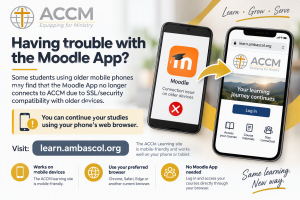
Having Trouble with the Moodle App on an Older Phone?
ACCM Student Notice Having Trouble with the Moodle App on an Older Phone? You can still access ACCM Learning directly through your phone’s web browser.
Why Every Christian Is Called to Lead
Christian Leadership Why Every Christian Is Called to Lead Leadership is not reserved for pastors, ministry leaders or people with official titles. In God’s kingdom,
Updated Christian Leadership Course Now Live
Updated Christian Leadership Course Now Live Equipping disciples for servant-hearted leadership in the mission of Jesus Christ. Ambassador College of Christian Ministry (ACCM) is pleased
The Bible and Doctrines: ACCM’s New Foundational Course is Now Live
The Bible and Doctrines Now Live | Build a strong foundation in Scripture, biblical interpretation, and Christian doctrine through a Christ-centred and Trinitarian lens. At