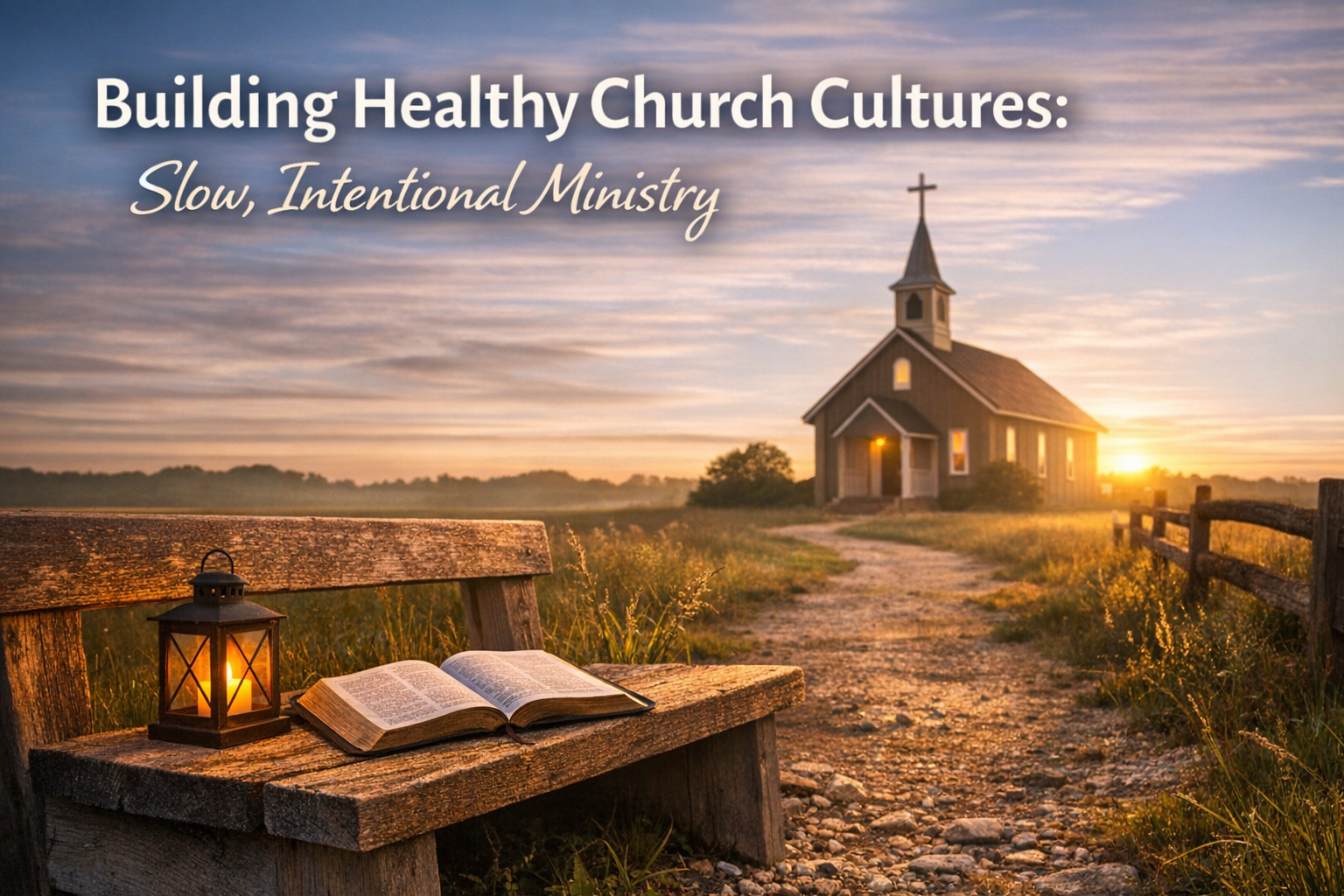
Building Healthy Church Cultures: Slow, Intentional Ministry
In an age that often rewards speed, visibility, and rapid results, the life of the Church can be tempted to follow the same patterns. Growth can become something to measure quickly, success something to demonstrate visibly, and ministry something to scale efficiently.
Yet the way of Jesus is often very different.
Healthy church culture is rarely built quickly. It is formed over time—through relationships, faithful teaching, consistent care, and a shared commitment to living out the gospel together. In many ways, the most meaningful ministry is not fast, but slow and intentional.
Rethinking What “Healthy” Means
When we speak about a healthy church, it is easy to focus on numbers, programs, or activity levels. While these can be indicators of life, they are not the foundation of it.
A healthy church culture is shaped by deeper realities:
- A Christ-centred identity
- A commitment to Scripture
- Genuine, loving relationships
- A spirit of humility and service
- A shared participation in God’s mission
These qualities cannot be rushed. They are formed as people walk together over time, learning to trust, serve, forgive, and grow in Christlikeness.
This is why intentionality matters. Healthy culture does not happen by accident—it is cultivated.
The Value of Slowness in Ministry
Slowness is not weakness in ministry—it is often wisdom.
Jesus himself invested deeply in a small group of disciples. He taught, walked, corrected, encouraged, and modelled life with the Father. His ministry was not rushed, yet its impact has been eternal.
In the same way, churches today are strengthened not by doing more, but by forming people more deeply.
Slow ministry allows space for:
- Meaningful discipleship
- Thoughtful teaching
- Pastoral care that is personal, not rushed
- Leadership development that is relational, not transactional
It also allows leaders to listen well—to God and to people—rather than simply reacting to pressure or expectation.
Intentional Leadership Shapes Culture
Church culture is often shaped most strongly by its leaders—not simply through what they say, but through what they consistently model.
Intentional leaders:
- Prioritise people over programs
- Make time for relationships
- Teach Scripture with clarity and faithfulness
- Create space for others to grow and serve
- Lead with humility, not control
They understand that culture forms in the “everyday”—in conversations, decisions, responses to challenges, and the way people are valued.
This kind of leadership cannot be developed overnight. It requires formation.
The Role of ACCM in Forming Healthy Leaders
This is where the work of Ambassador College of Christian Ministry (ACCM) becomes so important.
ACCM is not simply focused on delivering theological content. Its aim is to support the formation of leaders who can serve faithfully in the life of the Church—leaders who understand that ministry is relational, discipleship-focused, and grounded in the life of Christ.
Through its courses, ACCM helps students:
- Develop a deeper understanding of Scripture
- Grow in theological reflection
- Engage with real ministry situations
- Reflect on their own character and leadership
- Learn to apply biblical truth in practical ways
This kind of training contributes directly to healthy church culture. When leaders are shaped well, the communities they serve are strengthened.
ACCM’s emphasis on integrating study with local church life is especially important. Students are encouraged to apply what they are learning in real contexts—serving, leading, and growing within their congregations.
This ensures that learning is not disconnected from ministry, but actively contributing to it.
Building Culture Through Discipleship
At the heart of healthy church culture is discipleship.
Programs can be helpful, but they are not the goal. The goal is people growing in Christ—learning to follow Jesus in every area of life.
Intentional discipleship includes:
- Walking alongside others in their faith journey
- Investing time and attention in relationships
- Encouraging spiritual practices such as prayer and Scripture
- Helping people understand and live out the gospel
This kind of investment takes time. It requires patience, consistency, and trust in God’s work over the long term.
But it is also where lasting fruit is found.
Resisting the Pressure to Rush
Many ministry leaders feel pressure to produce results quickly. Whether internal or external, this pressure can lead to decisions that prioritise short-term outcomes over long-term health.
Slow, intentional ministry invites a different posture:
- Trusting God’s timing
- Valuing depth over speed
- Celebrating small signs of growth
- Remaining faithful in unseen work
This does not mean avoiding growth. Rather, it means focusing on the kind of growth that is sustainable, relational, and spiritually grounded.
Healthy culture grows best when it is nurtured patiently.
A Shared Commitment
Building a healthy church culture is not the responsibility of leaders alone. It is something the whole church participates in.
As each person grows in Christ, serves others, and contributes to the life of the community, culture is shaped collectively.
This is why formation matters—not just for leaders, but for all who are part of the Church.
The Long Work of Faithfulness
Slow, intentional ministry is not always easy. It requires perseverance, trust, and a willingness to invest in people over time.
Yet it is in this steady, faithful work that strong churches are built.
Communities shaped in this way become places where:
- People are known and cared for
- Scripture is lived, not just taught
- Leaders serve with humility
- Faith is nurtured across generations
This is the kind of culture that reflects the heart of Christ.
Looking Ahead
As churches continue to navigate changing contexts and challenges, the need for healthy, grounded, Christ-centred communities remains as important as ever.
Through intentional leadership, committed discipleship, and the thoughtful formation of leaders—supported by ministries such as ACCM—churches can continue to grow in ways that are faithful, sustainable, and deeply rooted in the gospel.
Because in the end, it is not speed that defines faithful ministry—but consistency, depth, and a long obedience in the same direction.